


Page 18 - Buku_Utama_ANMS_21122021_compressed
P. 18
NA TIONAL BL UEP RINT F OR BEHA V IOURAL INSIGHTS IN HEALTH
                                   MAINS TREAMING BEHA V IOURAL SCIENCE F OR BET TER HEALTH


                Behavioural science, as stated in the World Health Organization (WHO) resolution, is a
                multidisciplinary scientific approach that examines human action and its psychological, social,
                and environmental drivers, determinants and influencing factors (6). It is applied to protect
                and  improve  people’s  health  by  informing  the  development  of  public  health  policies,
                programmes  and  interventions  that  can  range  from  legislation  and  fiscal  measures  to
                communications  and  social  marketing,  as  well  as  to  support  other  public  health  efforts.
                While “behavioural science” and “behavioural insights” are often used interchangeably to
                describe the understanding of human behaviour, BI specifically refers to the lessons about
                human behaviour derived from behavioural sciences.

                The  application  of  BI  spans  a  wide  range  of  areas,  including  public  policy,  healthcare,
                finance, marketing, education (7), and more. By understanding the factors that influence
                behaviour, health stakeholders can design interventions, policies, and strategies that are
                more likely to achieve positive and beneficial outcomes (4).

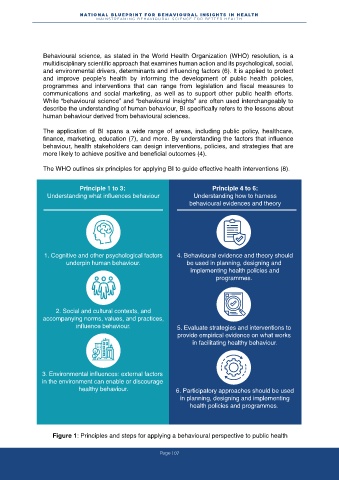
                The WHO outlines six principles for applying BI to guide effective health interventions (8).


                             Principle 1 to 3:                              Principle 4 to 6:
                  Understanding what influences behaviour             Understanding how to harness
                                                                    behavioural evidences and theory


                 1. Cognitive and other psychological factors  4. Behavioural evidence and theory should
                        underpin human behaviour.                  be used in planning, designing and
                                                                    implementing health policies and
                                                                             programmes.


                     2. Social and cultural contexts, and
                accompanying norms, values, and practices,
                            influence behaviour.                5. Evaluate strategies and interventions to
                                                               provide empirical evidence on what works
                                                                     in facilitating healthy behaviour.


                3. Environmental influences: external factors
                in the environment can enable or discourage
                             healthy behaviour.                6. Participatory approaches should be used
                                                                 in planning, designing and implementing
                                                                    health policies and programmes.


                   Figure 1: Principles and steps for applying a behavioural perspective to public health


                                                         Page | 07

