


Page 19 - Buku_Utama_ANMS_21122021_compressed
P. 19
NA TIONAL BL UEP RINT F OR BEHA V IOURAL INSIGHTS IN HEALTH
                                   MAINS TREAMING BEHA V IOURAL SCIENCE F OR BET TER HEALTH


                These principles address both the factors that shape behaviour and the methods for designing
                impactful strategies. The first three principles focus on understanding behaviours by identifying
                three key areas of influence: cognitive and psychological factors, cultural and social dynamics,
                and  environmental  elements,  including  physical  surroundings.  These  dimensions  are
                interconnected and collectively shape both individual
                and group behaviours. Considering  them together         Structural interventions such as
                provides  a comprehensive  view  of behavioural            policies that foster healthier
                drivers.  By  gathering  evidence  on  these  influences   environments are essential to
                and their interplay, valuable insights can be gained to      complement individual-
                guide effective interventions that encourage the
                adoption of desired behaviours.                                   focused efforts.

                The remaining three principles outline how to use behavioural evidence and theory to design,
                implement, and evaluate public health strategies. To effectively drive behavioural change,
                interventions must target specific enablers and barriers that influence the desired behaviour.
                Ongoing evaluation is essential to assess the effectiveness of these strategies, identify areas
                for  improvement,  and  refine  approaches  as  needed.  Equally  important  is  a  participatory
                approach, which involves engaging the affected communities in the design and implementation
                process. This builds trust, fosters collaboration, and ensures that interventions are tailored to
                the community’s context, thereby increasing their likelihood of success.


                Rather than assuming that individuals will naturally opt for healthier choices, this approach
                acknowledges the various obstacles they face and employs evidence-based strategies to
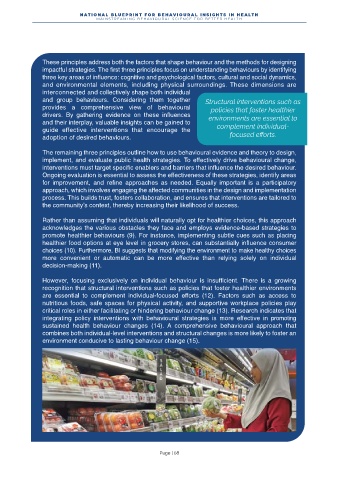
                promote healthier behaviours (9). For instance, implementing subtle cues such as placing
                healthier food options at eye level in grocery stores, can substantially influence consumer
                choices (10). Furthermore, BI suggests that modifying the environment to make healthy choices
                more  convenient  or  automatic  can  be  more  effective  than  relying  solely  on  individual
                decision-making (11).

                However,  focusing  exclusively  on  individual  behaviour  is  insufficient.  There  is  a  growing
                recognition that structural interventions such as policies that foster healthier environments
                are  essential  to  complement  individual-focused  efforts  (12).  Factors  such  as  access  to
                nutritious  foods,  safe  spaces  for  physical  activity,  and  supportive  workplace  policies  play
                critical roles in either facilitating or hindering behaviour change (13). Research indicates that
                integrating  policy  interventions  with  behavioural  strategies  is  more  effective  in  promoting
                sustained  health behaviour  changes  (14).  A comprehensive behavioural approach that
                combines both individual-level interventions and structural changes is more likely to foster an
                environment conducive to lasting behaviour change (15).


                                                         Page | 08

