


Page 48 - Buku_Utama_ANMS_21122021_compressed
P. 48
NA TIONAL BL UEP RINT F OR BEHA V IOURAL INSIGHTS IN HEALTH
                                   MAINS TREAMING BEHA V IOURAL SCIENCE F OR BET TER HEALTH


                 The  application  of  BI  has  gradually  influenced  policy-making  worldwide  by  integrating
                 findings  from  psychology  and  behavioural  economics  to  design  more  effective  public
                 policies. These insights aim to account for the actual behaviour of individuals, community
                 and  organisations,  moving  beyond  reliance  on  traditional  assumptions  about  human
                 behaviour.
                                              Over the past two decades, BI has been increasingly used in
             Over the past two decades,       countries around the world. In some countries, BI has been
               BI has been increasingly       institutionalised within government policy-making, like in UK,
            used in countries around the      Australia,  Japan,  US  and  some  countries  in  Europe,
                        world.                demonstrating their effectiveness in areas like tax collection
                                              and health warnings on cigarette packages. Governments
                                              are leveraging BI to encourage compliance, enhance public
                 and business interactions, and promote social and environmental responsibility in businesses.
                 This is achieved through a range of techniques, from nudges to corporate transparency
                 measures (24).

                 Since the establishment of the inaugural Behavioural Insights Unit in 2010 within the United
                 Kingdom Cabinet Office, numerous BI teams have emerged globally. While they differ in
                 their missions, models, and methodologies, they all share a common goal – to deepen our
                 comprehension of 'what motivates people' and to apply this knowledge to improve policy
                 and society.

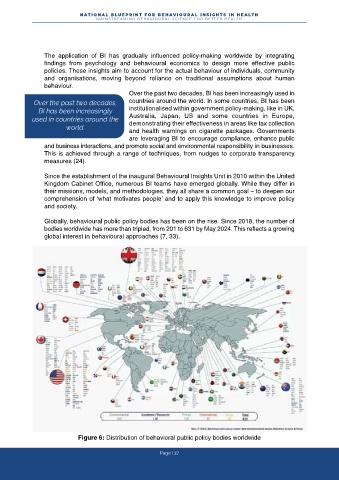
                 Globally, behavioural public policy bodies has been on the rise. Since 2018, the number of
                 bodies worldwide has more than tripled, from 201 to 631 by May 2024. This reflects a growing
                 global interest in behavioural approaches (7, 33).


                            Figure 6: Distribution of behavioral public policy bodies worldwide


                                                         Page | 37

