


Page 7 - Buku_Utama_ANMS_21122021_compressed
P. 7
FOREWORD


            The evolving landscape of public health calls for a deeper understanding of the human experience.
            A transformative shift toward the biopsychosocial model, one that thoughtfully integrates biological,
            psychological,  and social dimensions  of health  in a cohesive and evidence-informed manner, is
            essential in understanding human health behaviour.

            Behavioural science provides valuable tools to understand and influence the human factors that
            shape health outcomes. Whether addressing risk behaviours, improving treatment adherence, or
            promoting  preventive  actions, evidence  shows  that health systems are more effective when
            designed  around  how  people  actually  behave,  not  just  how  we  expect  them  to.  This  requires
            embedding behavioural insights at the core of health policy, planning, and service delivery at every
            level of the system.

            The adoption of behavioural science must now progress from inspiration to implementation. It is time
            we institutionalise behavioural science as a core function of our health governance and operations.
            This involves building the capacity of our health workforce to apply behavioural tools, integrating
            behavioural  insights into programme design, implementation  and  evaluation,  and  collaborating
            across sectors to co-create environments  that make healthy choices easy,
            attractive, and sustainable. We must act with urgency and unity, drawing
            upon our collective commitment to delivering health services that are
            people-centred, resilient, and responsive to the evolving needs of our
            communities.

            We  are thankful to  the  former Director General of  Health  for  the
            leadership in driving behavioural science to strengthen our health
            system. Moving forward, let this National Blueprint be more than a
            plan. It must be a catalyst for system transformation that puts people
            and behaviour at the centre of everything we do.

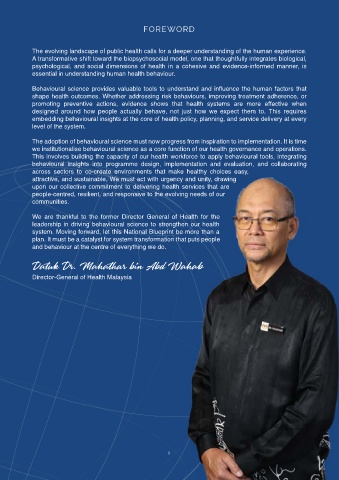
            D   Dr. M  har b  Abd W

            Director-General of Health Malaysia


                                                            ii

